


A practical guide to cloud modernization for engineering leaders and technology executives transforming enterprise infrastructure.
Imagine your cloud migration just wrapped. On time, on budget, celebrated in the all-hands. The slide deck looks great. Then, three months later, someone pulls the numbers, and the business outcomes you expected aren’t there. Release cycles are the same. The architecture didn’t change. The operating model didn’t change. The only thing that noticeably moved was the cloud bill.
Nobody did anything wrong, exactly. The migration succeeded by every metric it was measured against. The problem is that nobody asked, before any of it started, what problem it was actually supposed to solve.
This scenario plays out more often than most technology leaders want to admit. Migration and modernization aren’t the same thing but they’re treated as if they are, and the difference ends up costing millions.
Migration is a single event. Modernization is an ongoing commitment to evolving how your systems are built, deployed, and operated. Done right, it gives your engineering teams the speed, flexibility, and reliability to deliver what the business demands. Done wrong, it creates new layers of complexity on top of old ones, and a growing cloud bill with very little to show for it.
This guide is for technology executives, engineering directors, and cloud architects who want a clear framework for planning and executing cloud modernization at the enterprise level. What modernization actually means, the five paths available to you, the failure modes to avoid, and how to build a team capable of seeing it through.
- Cloud Modernization vs. Migration: Why the Difference Matters
- Why Cloud Modernization Is No Longer Optional
- The Five Paths: Choosing the Right Strategy for Each System
- Multi-Cloud and Hybrid Cloud: Architecting for Resilience and Flexibility
- The Six Most Common Cloud Modernization Failure Modes
- Before You Start: Five Questions That Shape Everything
- What a Phased Roadmap Actually Looks Like
- FinOps: Closing the Gap Between the People Building and the People Paying
- Building the Team: Internal Ownership and External Capacity
- How Gorilla Logic Approaches Cloud Modernization
Cloud Modernization vs. Migration: Why the Difference Matters
Cloud modernization is the process of evolving your applications, infrastructure, and engineering practices to take full advantage of what cloud-native platforms offer: elasticity, automation, resilience, and speed.
It encompasses a wide range of activities — re-architecting monolithic applications into microservices, adopting container orchestration with Kubernetes, establishing DevOps and SRE practices, migrating legacy databases to managed cloud services. What unites all of these efforts is the same goal: eliminating the technical debt and operational constraints that slow engineering teams down and limit the business’s ability to innovate.
What cloud modernization is not:
- It’s not simply moving an on-premises workload to a cloud VM (that’s lift-and-shift migration, and it rarely delivers meaningful value on its own).
- It’s not a one-time project with a defined end date.
- It’s not something that can be delegated entirely to a cloud vendor or a staff augmentation provider without strategic leadership from within.
The most successful cloud modernization programs treat modernization as a continuous engineering discipline: a way of working, not a destination.
Why Cloud Modernization Is No Longer Optional
For most of the last decade, cloud modernization was a competitive advantage. Today, it’s closer to the cost of doing business. The enterprises that haven’t modernized are increasingly outpaced, not just technically, but in their ability to attract talent, move quickly, and serve customers.
Speed to market. Legacy architectures impose long release cycles, manual deployments, and high coordination overhead. Modern cloud-native systems enable continuous delivery, independent deployment, and dramatically shorter feedback loops between engineering and customers.
Operational cost. Aging infrastructure is expensive to maintain, license, and staff. Cloud modernization, when paired with a FinOps discipline, can significantly reduce total cost of ownership, particularly for workloads with variable demand.
Engineering talent. Top software engineers don’t want to work on outdated stacks. Modernizing your platform is also a talent strategy, it’s how you attract and retain the engineers who can drive the next phase of your business.
Resilience and security. Legacy systems are disproportionately vulnerable to outages and security incidents. Modern cloud architectures, built with observability, redundancy, and zero-trust principles, are far better equipped to meet the reliability and compliance standards the business requires.
AI and data readiness. The wave of AI-powered product capabilities that enterprises are now racing to deliver depends on a modern data and cloud foundation. If your infrastructure isn’t modern, your AI ambitions will be blocked at the platform layer.
The Five Paths: Choosing the Right Strategy for Each System
There is no single path to cloud modernization. The right approach depends on the age and complexity of your systems, the risk tolerance of the business, the capacity of your engineering team, and the urgency of your goals. Most enterprise modernization programs combine several of these paths simultaneously across different parts of the portfolio.
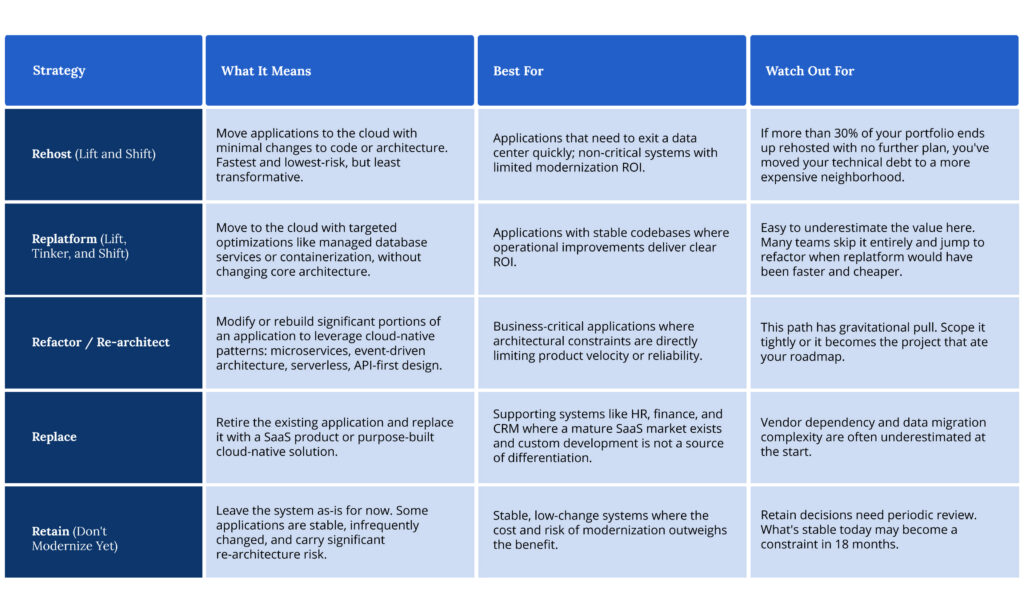
In practice:
A global aerospace company came to us with a satellite imaging platform where a monolithic system was making image retrieval so slow it was visibly hurting the customer experience, and legacy tape storage meant the system couldn’t scale to the data volumes the business required. We migrated petabytes of data to AWS using Snowball, decomposed the monolith into microservices, and introduced CI/CD pipelines for automated deployments. Image processing time dropped from 90 minutes to a few minutes. That’s not an incremental improvement, it’s a fundamentally different product.
Multi-Cloud and Hybrid Cloud: Architecting for Resilience and Flexibility
For most large enterprises, the cloud modernization question has shifted. It’s no longer about which cloud to choose. It’s about how to manage multiple clouds strategically.
Multi-cloud architectures, where workloads are distributed across AWS, Google Cloud, Azure, or others, have become the default for enterprise technology organizations. The motivations vary: avoiding vendor lock-in, optimizing cost by workload type, meeting regulatory or data residency requirements, or leveraging best-in-class managed services across providers. Hybrid cloud extends this further, maintaining a deliberate mix of on-premises infrastructure and public cloud, often as a long-term architecture decision rather than a transition state.
The benefits of multi-cloud done right:
- Resilience: no single point of failure at the infrastructure level
- Cost optimization: match workloads to the platform where they run most efficiently
- Flexibility: avoid dependency on a single vendor’s pricing, roadmap, or service availability
- Regulatory compliance: meet data sovereignty requirements by region or jurisdiction
The risks of multi-cloud done poorly:
- Complexity: managing multiple control planes, billing models, security frameworks, and toolchains dramatically increases operational overhead
- Skill fragmentation: teams need deep expertise across multiple platforms, which is difficult to build and retain
- Cost sprawl: without strong FinOps governance, multi-cloud can multiply cost inefficiency rather than reduce it
The key word is intentionality. Multi-cloud is not a strategy in itself. It’s an architectural pattern that needs to serve a clear set of business and technical requirements. The organizations that get the most value from it invest upfront in a coherent platform strategy, a unified observability and security model, and a FinOps practice that keeps costs accountable across providers.
The Six Most Common Cloud Modernization Failure Modes
Understanding what goes wrong is as important as understanding what to do. These are the failure modes we see most frequently in enterprise cloud modernization programs.
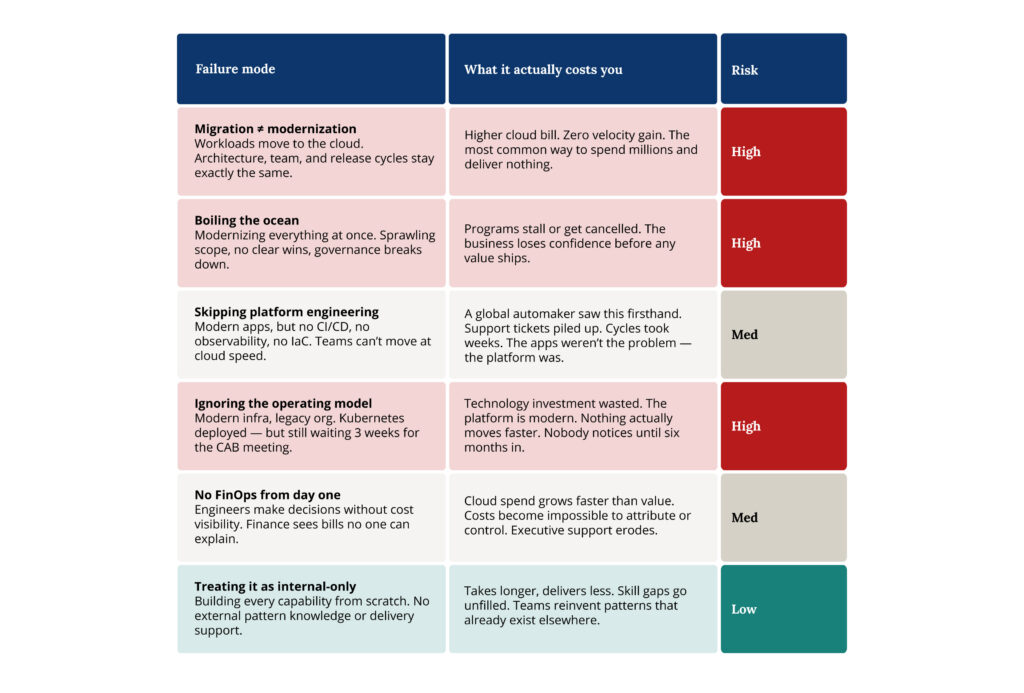
In practice:
Skipping platform engineering is easier to miss than it sounds. A global automotive manufacturer came to us with this exact problem: their internal cloud development portal had become the bottleneck for dozens of engineering teams. Outdated components, no automation, and a support queue growing faster than the team could clear it. The problem wasn’t the applications sitting on top of the platform, it was the platform itself. After modernizing with automated pipeline-driven UI generation, reusable components, and GitOps workflows, monthly support tickets dropped by 66% and development cycles that had stretched to days or weeks compressed to a few hours. The applications didn’t change. The platform underneath them did.
Before You Start: Five Questions That Shape Everything
Move these to the front of your planning process. The answers shape every decision that follows: from team structure, to technology choices, to how you measure and communicate progress to the business.
- What is the business outcome we’re trying to achieve, and how will we measure it? Not “modernize our infrastructure.” The downstream business result: faster release cycles, lower operational cost, a specific product capability that’s currently blocked.
- Which systems in our portfolio are constraining us most, and which are stable enough to leave alone? A clear map of what to prioritize, what to replatform, and what to retain is more valuable than a modernization roadmap that touches everything.
- Do we have the internal leadership and architecture capacity to own this program, even if we partner for delivery? External partners can accelerate execution. They can’t substitute for internal ownership of architecture decisions and long-term accountability.
- What does our current cloud cost look like, and do we have the governance in place to manage it as we scale? If you can’t answer this clearly before you start, you won’t be able to answer it after.
- Are our stakeholders aligned on a phased, iterative approach? Programs that fail often do so because the business expects a single transformation event. The most successful ones are structured as continuous improvement.
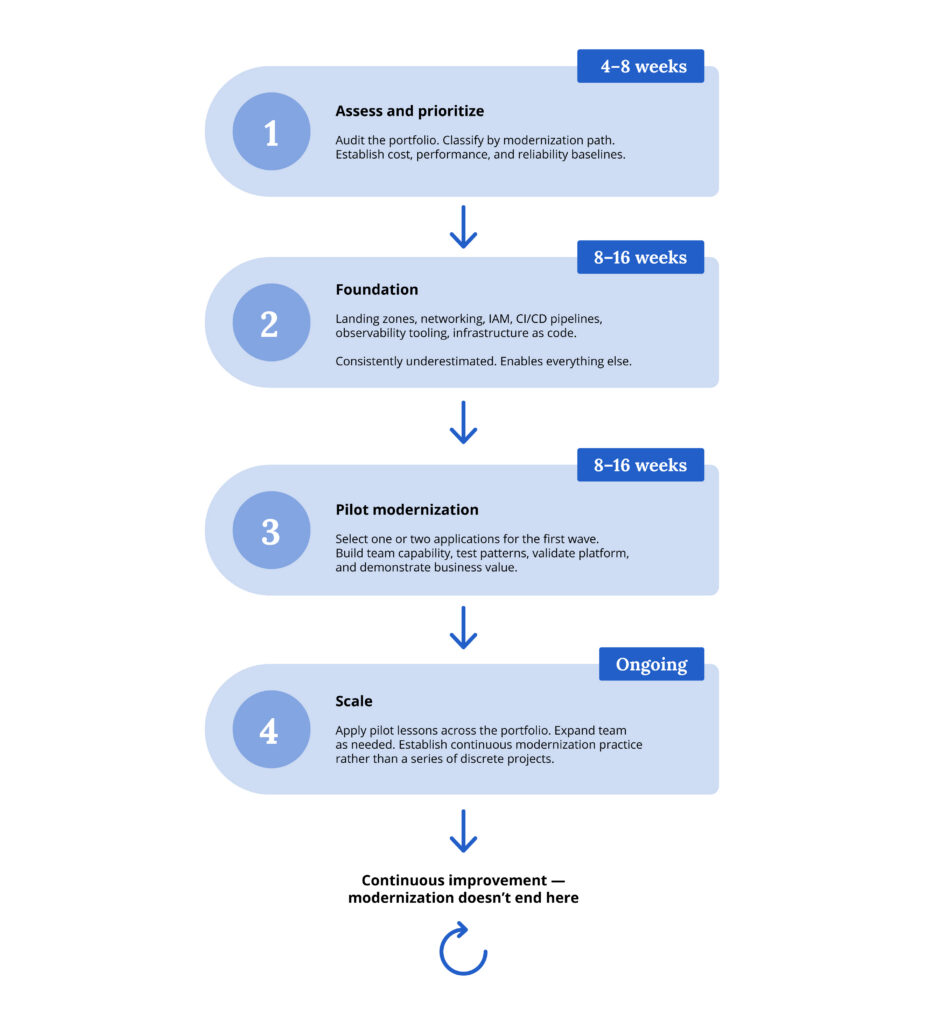
What a Phased Roadmap Actually Looks Like
Every modernization program is different, but the most effective ones share a common structure: short phases, clear outcomes, and continuous learning.
FinOps: Closing the Gap Between the People Building and the People Paying
The FinOps model, a cultural and operational practice that brings engineering, finance, and operations into shared accountability for cloud costs, is the most effective framework for managing cloud economics at scale.
In practice, it requires a few structural commitments:
Tag everything from day one. Resource tagging is the foundation of cost attribution. It’s far harder to retrofit than to implement at the start.
Measure unit economics, not just total spend. The right question isn’t “how much are we spending on cloud?”, it’s “how much does it cost to deliver one unit of value?”
Make costs visible to the people making architectural decisions. Engineers who can see the cost implications of their choices make better decisions. Embed cost dashboards into developer workflows, not just finance reporting.
Optimize continuously, not episodically. Cloud cost optimization is not a one-time project. Build it into the engineering operating cadence, sprint by sprint, service by service.
Building the Team: Internal Ownership and External Capacity
One of the most consequential decisions in any cloud modernization program is the team model, and the honest answer for most enterprise organizations is that you need both.
Internal teams must own architecture decisions and technical strategy, business and domain knowledge that can’t be transferred to a vendor, long-term platform ownership and operational accountability, and cloud governance, security standards, and compliance.
External engineering partners add the most value by accelerating delivery when internal capacity is the constraint, bringing deep and current expertise in specific platforms and technologies, providing pattern knowledge from similar modernization programs across industries, and establishing engineering practices (CI/CD, SRE, infrastructure as code) that internal teams can own over time.
The most effective model isn’t staff augmentation or outsourcing; it’s a collaborative engineering partnership, where external teams work as an integrated extension of the internal organization, sharing accountability for outcomes. Nearshore engineering teams based in Latin America and working in U.S. time zones have become the preferred model for many U.S. enterprises, combining deep technical talent with the collaboration and cultural alignment that distributed delivery requires.
How Gorilla Logic Approaches Cloud Modernization
We helped a global aerospace company cut satellite image processing time from 90 minutes to a matter of minutes by replacing a legacy monolith with cloud-native microservices on AWS. We helped a global automaker reduce engineering support load by 66% by modernizing the developer platform their teams depended on every day.
The pattern is the same in both cases: the right modernization path, executed with engineering discipline, changes what the business can do, not just how the infrastructure is organized.
Our engagements combine solution architects with deep expertise in AWS, GCP, and Azure; agile nearshore engineering teams based in Latin America, working in your time zone; Gorilla Logic Construct™, our portfolio of delivery-tested workflows and modular AI agents that accelerates platform setup, infrastructure as code, and CI/CD pipelines; and SRE and DevOps practices that ensure your modernized platform is observable, resilient, and continuously improving.